You made the jump. Now let's make you a serious Hermes user.

You've got Hermes Agent Desktop installed on your own machine, and you've seen it do something real. Good. This page is about everything that comes after that.

Get the full e-Playbook · $79
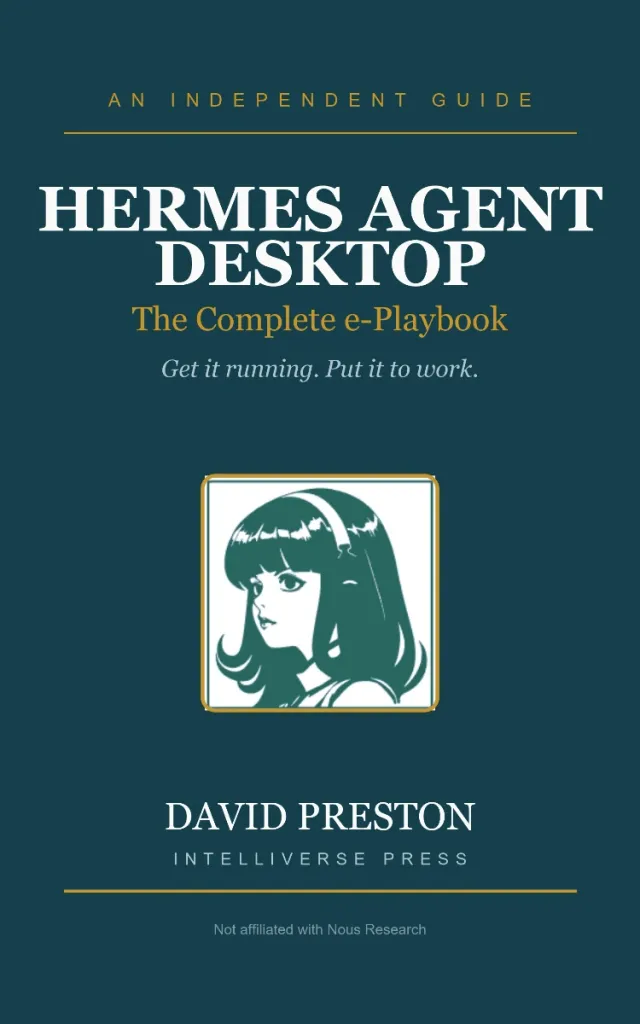
Hermes Agent Desktop: The Complete e-Playbook, by David Preston — book cover

You came here from a page in one of my books. That's how you got here, and I'm glad you did.

Here's roughly what I know about you. You read the Introduction. You worked through the setup, which means the app is on your own computer and running. Maybe you went further and pointed it at a real folder and watched it do the work while you sat there. Either way, you're not standing at a locked door anymore.

That's worth stopping on for a second, because that door is where the playbook opens, and most people never get through it. They watch five tutorials and quit at a warning screen. You didn't. You're inside.

So I'm not going to spend this page selling you on the door. You already opened it.

What I want to do instead is show you the rest of the house. Because what you've done so far, and I say this with real affection for it, is the small end of this thing. You've got an agent that does a task. What's waiting is an agent that knows your business, runs while you sleep, and takes real work off your desk every week without being asked twice.

That's a different animal. Let's go get it.

Where you are on the road

  1. InstallDone. The app is on your machine.
  2. First WinYou've watched it do real work.
  3. GrowYou are here. This is the playbook.

What your own agent actually does for you

Let me show you five small scenes. None of this is science fiction, and none of it needs you to be technical. It's just an ordinary Tuesday, once you're set up.

The folder that organizes itself.

You point Hermes at that download folder... you know the one, four hundred files named "scan_final_FINAL_v3"... and ask it to sort the mess into sensible folders and write you a short note on what it did. A few minutes later it's done, there's a tidy summary sitting on top, and you didn't touch a thing. (You may have already done this one. It's the first win.)

The brief that's waiting at 6:30 a.m.

Before breakfast, there's a short note on your screen: three things that need you today, two emails worth answering first, the one number from yesterday you actually care about. You asked for it once, last week. Now it just shows up. (You build this one in Chapter 4.)

The stack of documents, digested.

Forty pages of a contract, a vendor proposal, the benefits packet nobody reads. You hand it over and ask the plain question, "what changed, and what should worry me?", and back comes a straight answer, page numbers and all, in the time it takes to refill your water glass.

The agent that remembers your business.

Not just this conversation... your customers, your constraints, the three things that make your shop different from the textbook. You tell it once. After that, every answer arrives already knowing the ground you stand on. (Chapter 5 shows you how its memory actually works, and how to fix it when it remembers wrong.)

The one that works while you sleep.

You leave a job running... pull these numbers, draft these replies, watch this inbox... and you go live your evening. In the morning the work is done and waiting, like the dishwasher you ran overnight. Except this one filled itself. (Chapter 7 covers what has to stay on for that to actually happen, the part the demos skip.)

Notice how much of that sits past where your sample stops. That's not an accident of where I cut it. That's just where the good part starts.

What the full playbook gives you

So here's the road, chapter by chapter, and where you are on it. You've read the Introduction and you're through the setup. Everything below that is what you're buying.

Up and Running

The install, Windows first, every screen shown. The SmartScreen moment, explained. What the installer quietly handles for you, and the one prerequisite Mac and Linux users still need. The official download source, so you don't land on a look-alike site.

Your First Win

One complete use case, start to finish, with your own messy folder. The win on the board.

The Full Tour

Every feature, walked with screenshots, so the app stops feeling like a cockpit.

The Agent Copilot

The deeper move... pointing a second AI at your actual install to read your config, explain it, and fix it. (It's how this book got made.)

How Your Agent Thinks

Context, memory, skills, connectors, bounded to exactly what you need to run Hermes well, no computer-science detour.

Choosing the Brain

Which model, real monthly dollar costs for a small-business workload, and a straight answer to "can I just use my Claude subscription?" (You can't, and I'll tell you why.)

Where Your Agent Lives

Local versus always-on, and what the 6:30 a.m. brief really requires.

The Use-Case Library

The capstone. Several full cases, plus the prompting method that teaches you to build your next five using your own business, plus a list of 25 more starter prompts to grow into.

That's the written playbook. Here's the rest of what comes with it:

  • The complete playbook: all nine chapters, every step, every snag pre-empted.
  • The full companion Vault: audio companions, visual walkthroughs, slides, and 1-page quick guides for the chapters.
  • The teach-to-fish prompting guide, so you can build your own use cases, not just run mine.
  • The growing use-case library, plus 25 more starter prompts to grow into.
  • Year One of living updates, free. Every four-to-six-week refresh for a full year, included in the $79.

Why this is worth more than it costs

One thing you should know, because it shapes everything, and it's the reason this costs what it costs.

Hermes is moving fast. In the nine days around when I started this, the project shipped three major releases. The build I started on was v0.16.0; by the time you're reading this it's already old news, v0.17.0 and counting, and it moves briskly enough that a normal book would be out of date before the ink dried.

So this isn't a normal book. It's a living playbook. It carries a visible revision log, and it gets refreshed every four to six weeks. The parts most likely to drift... the exact buttons, the screen names, the install wizard... are exactly the parts I keep current. When the app changes, the playbook changes, and you get the update.

You already know this is true, by the way. You've had the app open. You've seen it update.

That's the whole reason the subscription exists, and I want to be plain about it. You're not paying for a snapshot of June 2026. You're paying for current. Every four to six weeks, when Hermes ships something new, you're the reader who already has the updated steps, and a growing library of new use cases, instead of the one squinting at a tutorial that no longer matches the screen in front of them.

A tool that changes weekly needs a guide that changes with it. That's the deal.

One honest comparison, because it matters: a guide like this competes with the consultant you're not hiring, the one who'd charge a few thousand dollars to sit with you for a few weeks. Eighty dollars to get there yourself, with the steps in hand and the updates included, is a different kind of deal.
Who this is for, and who it isn't

You do not need to become a programmer, and I'm not going to pretend you do. If you can write an email and copy a file, you can do everything in these pages. That's the bar. The earnest beginner beats the casual expert every time, and this playbook is built for the earnest.

Who it's probably not for: if you're a developer who lives in the terminal and just wants the API reference, you'll find this gentle... the official docs will serve you faster. And if you're hoping to skim a summary and feel informed without doing the work, this isn't that either. This is a roll-your-sleeves-up, do-it-alongside-me book. You'll need a focused hour and a real folder to point it at. The right reader is energized by exactly that.

The full e-Playbook: $79, one-time.

Founding-member price: $79. It rises as the library grows, so lock in today's rate, and your first year of updates, now.

After Year One: keep it current for $29.95/year.
When your first free year is up, the keep-current subscription holds the line: you stay on the latest build's steps, you keep getting new use cases as the library grows, and you keep your Vault access. Let it lapse and the playbook stops updating... you keep what you've got, but you stop getting current. Renew anytime to pick the updates back up.

My guarantee. Put in the hour and don't get your first win? Email me inside 30 days for a full refund. The risk is mine, not yours.

Questions you might still have

I already read the sample. Does the full playbook just repeat it?

It contains it, and then it keeps going. The full edition runs the Introduction through Chapter 8, so the chapters you've read are in there, polished and current, and then the rest of the book follows: the full tour, the copilot method, honest model costs, how your agent's memory really works, what always-on actually takes, and the use-case library. The Vault comes with it. What you've read so far gets you installed and gets one win on the board. The rest is the part where this becomes a tool you run your work on.

What is the subscription actually for?

Staying current. Hermes ships updates roughly weekly, and the playbook refreshes every four to six weeks to match: new screens, corrected steps, and a growing library of use cases. Year One of those updates is included in the $79. After that, $29.95/year keeps them coming. You're subscribing to current, not to access you already paid for.

Is my data private?

Yes, and that's a big part of why Hermes is worth your time. It runs on your own computer. Your files stay on your machine, not parked in somebody else's cloud. There's no telemetry. The playbook also includes a running "Keys to the Kingdom" thread on permissions, so you know exactly what the agent can reach and how to keep the rest locked down.

What does it cost to run Hermes itself?

Hermes is free and open-source. You pay only for the AI model usage behind it, and for a typical small-business workload that's modest... community setups run a few dollars a day. Chapter 6 lays out real numbers and shows you how to pick a path that fits your budget, including the cheapest good options.

What if I get stuck?

Two things. First, the playbook is built around the snags... the failure points that stop most people on day one have their own fixes, shown step by step. Second, every tricky step comes with a "paste it to your copilot" version: keep a free AI chat open in a browser tab, hand it the error or the confusing screen, and let it walk you through. You're never staring at a wall alone. And if it still doesn't deliver, the 30-day money-back guarantee has you covered, no hard feelings.

Windows or Mac?

Both. The playbook leads Windows-first, because that's where the tutorials are thinnest and the snags are real (the SmartScreen warning, the Git prerequisite, the install wizard nobody documents). Mac gets its own parallel path. One honest note for Mac users: the current Hermes installer is Apple-silicon only, so older Intel Macs can't run it yet... I tell you that up front so you don't find out the hard way.

Why isn't this on Amazon like a normal book?

Because a living playbook can't live on Amazon... there's no clean way to push you updates and a growing Vault through it. Selling it directly is what lets me deliver every refresh straight to you for a year. (There is a short Amazon ebook to dip a toe in, if you found me there, but the full playbook, the Vault, and the updates live here.)

You already did the hard part. You picked up the tool.

Most people never get that far. They watch the tour, they nod along, and the app never lands on their machine. You're past that, which means the next stretch is the fun one: pointing this thing at the work you actually don't want to do, and watching it hold up its end.

Set aside one focused hour this week. Come get the rest of it.

Founding price, locked for keeps. Year One of updates included, starting the day you buy. Thirty days to change your mind, no runaround.

Onward and upward.